
















.svg)









.svg)











.png)


There is an axiom of good software craftsmanship that goes like this:
A function should do one thing and do it well.
Never heard that before? Yep. It's a thing – an industry-accepted principle for crafting good software. But why? Why is this a thing?
Why?
Well, functions that do one thing are small. How small? Oh, say, 20 lines or less. Yes, and smaller. But imagine the benefits of a small function.
- Easy to name. A function's name tells you what it does. One-thing functions are easy to name.
- Easy to read. We can understand the function's code at a glance. We don't have to navigate a hundred lines of code with five levels of conditions waving down the page like snow geese in a multi-V flying formation, weaving in and out of 2 loops.
- Easy to change. It's easier to change 20 lines of self-contained code than 100 lines of snow geese formations.
- Easy to test. We can test a small function independently. Pop it into a background script. Test, fix, and copy the revised code back. Done. Try that with the snow-geese function.
Only One Thing?
But wait, you say some functions must do more than one thing.
Well, sure.
But they do this by invoking other functions that do one thing. So higher-level functions should read like a checklist as they invoke other functions to do the work for them. Like this:
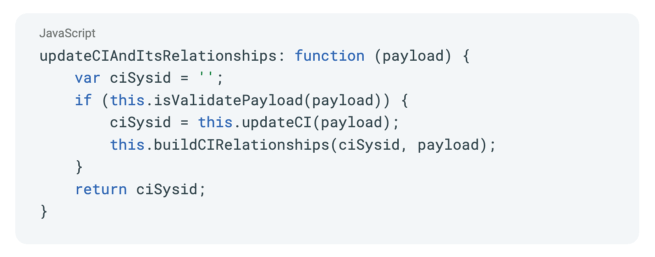
Some functions just organize the work. They give us a logical flow without the details. If you want details, then you have the option of drilling down into lower-level functions. When traversing a giant function with multiple snow geese formations, you don't have that option.
What’s in a Name?
There's a corollary to the one-thing principle.
If a function does one thing well,
its name should say, well, what it does.
Small functions are only as helpful as the names we give them. We should know what a function does simply by reading its name. We spend about 75% of our time understanding code, 20% of our time changing it, and only 5% writing it (source). Well-named functions save everyone time and mental cycles.
Functions do something or answer a question. Do-something functions use an action verb to describe what they're doing.
- getIncidentsForAssignmentGrp(assignmentGroup)
- calculateIncidentPriority(grIncident)
- updateCIRelationships(ciSysid, payload)
Functions that answer a question always return a boolean. We name them as a question for clarity.
- isValidPayload(payload)
- isApprovalRequred(grChange)
- isCIDataStale(grCI)
isBlogPostDone()
True. For now, at least. There are other important principles that we can explore later. But crafting good functions is fundamental to crafting good code.
A function should do one thing and do it well.
If a function does one thing well,
its name should say, well, what it does.